
In our last blog, we explored process goals for building skills and resilience. This week, we’re adding one of the most immediate and accessible tools available to any athlete: breathing techniques for instant relief. Simple to learn, available to you at any moment, and backed by solid research — controlled breathing can make a genuine difference to your wellbeing, your mental state, and your performance.
Why Breathing Works
Breathing exercises have been used for centuries in meditation and mindfulness traditions, and they are now a well-established part of modern psychological and performance support. The reason they work comes down to how your body’s automatic systems function.
When you are stressed, anxious, or under pressure, your body activates its “fight or flight” response — heart rate rises, muscles tighten, and your thinking can become narrow and reactive. Controlled breathing works by directly stimulating the opposite system — what is sometimes called “rest and digest” mode — which calms the body and restores a sense of steadiness. Crucially, this is something you can trigger yourself, on demand, simply by changing how you breathe.
Slow-Paced Breathing: Your Calming Tool
Slow-paced breathing means breathing significantly slower than your natural resting rate — typically around six breaths per minute. At this pace, your breathing activates the vagus nerve, a key part of your body’s calming system, producing feelings of relaxation that can be felt almost immediately.
For your mental health and general wellbeing, the benefits are well documented. Even a single session of slow-paced breathing has been shown to produce an immediate reduction in anxiety. Practised regularly, it reduces overall stress levels, helps manage difficult emotions, and can improve sleep quality — all of which matter enormously for an athlete whose recovery depends on genuinely restful rest. It also helps break cycles of negative thinking by giving your attention somewhere concrete and calming to land.
For performance, the benefits are equally compelling. Slow-paced breathing improves concentration during intense activity, helps your body recover more quickly after physical effort by lowering heart rate and calming the nervous system, and is one of the most effective tools available for managing pressure in high-stakes moments. Research also shows that practising it consistently over time — not just in isolated moments — leads to measurable improvements in physical sport performance.
Other Approaches Worth Knowing
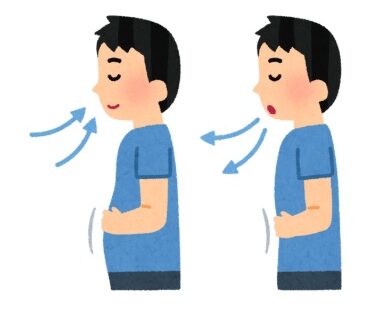
Slow-paced breathing is the most researched technique, but it’s not the only option. Some athletes find it helpful to deepen their breath by consciously breathing into the abdomen rather than the chest, which naturally slows the breath and engages the body’s calming response more fully. Others find that adding sound — humming during the exhale, for instance — enhances the effect.
Mindful breathing is another useful variation: rather than actively controlling the breath, you simply observe it — noticing its rhythm, depth, and texture without trying to change anything. This gentler approach can be particularly effective at disrupting unhelpful thought patterns, as it gently redirects attention away from mental noise and back to the present moment.
How to Use It: A Simple Starting Point
The most well-supported technique is straightforward to learn and requires nothing except your own breath.
Aim for approximately six breaths per minute. A simple way to achieve this is to inhale for a count of three, hold briefly for a count of four, then exhale slowly for a count of three — exhaling through pursed lips can help slow the breath naturally. If this feels uncomfortable at first, take slightly shallower breaths and focus on keeping the rhythm smooth and even rather than forcing depth.
Before competition or a stressful moment, use this technique to settle your nervous system, sharpen your focus, and manage pre-performance anxiety. Even two or three minutes can shift your mental state meaningfully.
During training or competition, controlled breathing can help you regulate your heart rate and maintain concentration during high-intensity moments — particularly useful in sports with natural pauses or intervals.
After exercise, slow breathing accelerates recovery by helping your body transition out of high-alert mode more quickly, lowering heart rate and reducing the residual tension that intense effort leaves behind.
The best thing about breathing as a mental tool is that it is always available to you — no equipment, no preparation, no ideal conditions required. Whether you’re in the changing room before a big competition, on the bench during a game, or lying awake the night before an important event, your breath is there. Learning to use it intentionally is one of the simplest and most reliable investments you can make in your mental performance.